


A linear motion shale shaker is the primary solids control equipment used on drilling rigs, HDD rigs and TBMs to remove drilled cuttings from drilling fluid. This article explains how vibration, G-force, screen selection and deck angle work together — and why there is no single “best” setting for every job.
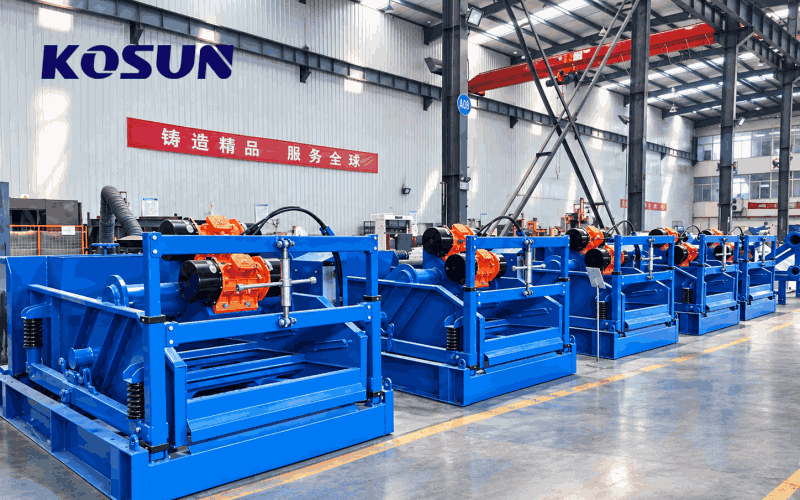
What Is a Linear Motion Shale Shaker?
A linear motion shaker produces a straight-line vibrating movement generated by a pair of counter-rotating vibration motors. The motion drives drilling fluid and cuttings across the screen deck: particles larger than the screen openings are retained and transported to the discharge end, while fluid and finer particles pass through. Controlled vibration supplies the energy that gravity or fluid flow alone cannot provide.
How Linear Motion Separates Solids from Drilling Fluid
- Feed: Drilling fluid with cuttings flows onto the back of the screen deck.
- Stratification: Vibration lifts and separates the bed, letting fluid migrate downward through the openings.
- Conveyance: The linear throw moves retained solids toward the discharge end.
- Discharge: Cuttings leave the shaker; treated fluid falls through to the mud tank for downstream processing.
G-Force: What Higher Vibration Really Does
G-force measures the acceleration applied to material on the deck. Higher G-force increases the energy available to move solids — useful under heavy cuttings loading — but it is not a standalone performance indicator. Screen condition, fluid rheology, solids loading and deck angle all matter. Raising G-force without considering these factors can increase screen wear and fluid loss without improving separation. Good shaker design is about operating balance, not maximum vibration.
Vibration vs Solids Conveyance: Finding the Balance
A shale shaker has two jobs that must work together: screening (letting the liquid phase pass through) and conveyance (moving retained cuttings off the deck). If solids travel too slowly, they pile up and reduce usable screen area; too fast, and residence time drops. Linear motion remains the dominant design for drilling-fluid shakers because it serves both functions with one controlled movement.
Adjustable Deck Angle: When to Change It
Deck angle changes how quickly material moves across the shaker:
- Steeper angle: faster conveyance — use with heavy, wet cuttings or high solids loading.
- Flatter angle: longer residence time — use when fluid recovery and finer separation are the priority.
The KOSUN LS584 features an AWD system that adjusts the screen basket from -1° to +5° in 0.5° increments, so operators can adapt to changing mud properties and formation conditions without stopping the pump.
Applications Beyond Oil & Gas
The same separation principle applies wherever drilling fluid must be cleaned and reused: HDD projects recycling bentonite-based fluids, and TBM operations handling high-solids slurry in continuous excavation. The KOSUN LS584 is built for all three applications.
Looking for a linear motion shale shaker?
Request a quote for the KOSUN LS584, or see how it fits into a complete solids control system.