


Mud cooling is a critical technical requirement in modern deep-well and geothermal exploration. High bottom-hole temperatures cause circulating fluid to absorb significant thermal energy. Without cooling, accumulated heat can trigger severe chemical and mechanical degradation throughout the drilling system. Effective thermal management is essential for maintaining fluid stability and protecting downhole equipment.
Onshore Thermal Management: Matching Systems to Water Availability
Therefore, onshore cooling solutions must be selected according to local utility access and cooling-water availability.
1. Direct Cooling for Water-Abundant Sites
Where water is readily available, direct cooling provides a high-capacity solution. The system uses large-diameter inlet piping to reduce clogging from suspended solids. Under standard operating conditions, units such as the KSNQ-150 deliver a consistent 20°C–30°C temperature reduction at flow rates up to 150 m³/h with a 1.6 MPa design pressure.
2. Closed-Circuit Systems for Water Conservation
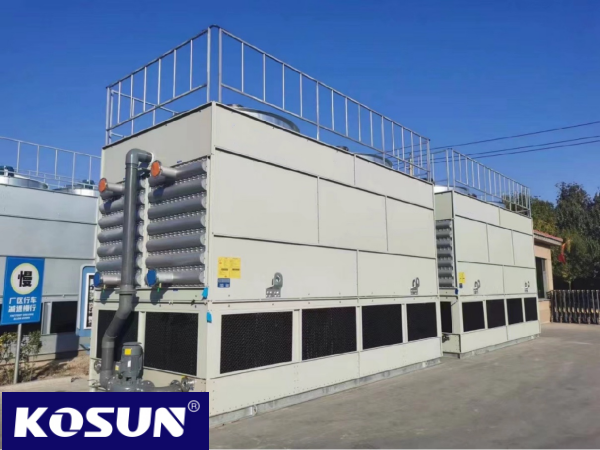
When regulations or operating costs require water conservation, a split-system design is preferred. A large plate heat exchanger works with a compact cooling tower in a closed circuit. This arrangement isolates the drilling fluid, minimizes evaporation losses, and supports flow rates up to 200 m³/h.
3. Air-Cooled Systems for Arid Environments
In desert regions where water is unavailable, ambient air serves as the heat sink. The system combines a heavy-duty plate heat exchanger with high-velocity air coolers. It provides a sustainable solution for remote operations with no ongoing water consumption after installation.
4. Chiller-Integrated Solutions for Sub-Ambient Cooling
A challenge emerges when the required mud temperature falls below the ambient air temperature. In water-scarce environments, a dedicated chiller is integrated into the air-cooling circuit. This hybrid approach overcomes ambient temperature limits and delivers reliable cooling for flow rates up to 200 m³/h.
Offshore Thermal Management: Addressing Space and Corrosion Challenges
Offshore platforms face strict space constraints and highly corrosive marine conditions, making standard materials unsuitable.
5. Titanium Plate Heat Exchangers Using Seawater
Offshore cooling systems utilize seawater as the primary cooling medium. To resist chloride-induced corrosion, they employ a titanium plate heat exchangers. Titanium offers excellent heat transfer performance and outstanding resistance to seawater pitting.
Beyond cooling, the compact design also helps overcome limited deck space. Units can operate individually or in parallel to accommodate higher mud circulation volumes during demanding drilling operations.
Conclusion
Successful thermal management depends on matching environmental conditions with the appropriate cooling architecture.Whether using air-cooled systems in deserts or compact titanium heat exchangers offshore, maintaining stable mud temperatures remains the most effective way to reduce high-temperature drilling risks.