


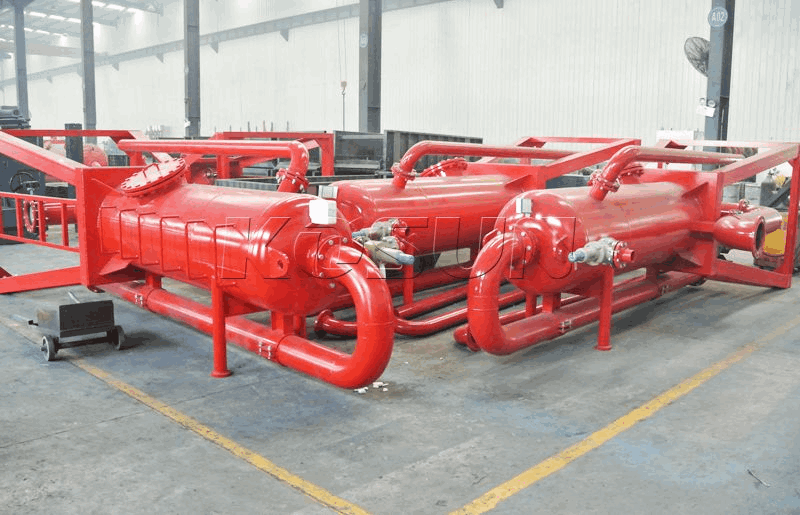
A Mud Gas Separator (MGS), or gas buster, is common on most drilling rigs worldwide. The MGS separates wellbore gas from drilling fluid. It is used while circulating out a kick, or whenever gas appears in the fluid during drilling or workover operations. The MGS is a critical component of underbalanced drilling. KOSUN offers high-performance mud gas separators engineered for safe and reliable gas removal in demanding drilling operations.
How a Mud Gas Separator Works
A typical MGS is constructed of a cylindrical vessel with a series of baffles. Drilling fluid from the wellbore enters the MGS. As the fluid hits the baffles, easily removed gas separates from the liquid. Gas exits through a vent line at the top of the MGS. It is then safely vented away from the rig floor. The mud exits the MGS through a line near the bottom “uphill” to return to the pit system.
Typically, the maximum allowable pressure of the MGS when in use is determined by the fluid leg (or fluid seal) height. The density of fluid in the fluid leg is dependent on the fluid in use at the time, and, therefore, operating pressure of the system is variable. This pressure is usually below 15 psig . However, there are MGS applications in which the vessel can operate at pressures up to 100 psi .
The friction pressure of the gas flowing through the vent line must be less than the hydrostatic pressure of the fluid in the fluid leg. If this friction pressure is greater than the hydrostatic pressure in the fluid leg, gas will exit the fluid line and flow to the pit system.
Key Factors for Proper MGS Sizing
There are numerous factors that go into properly sizing an MGS system:
🔹Kick Size: A reasonable scenario for a kick size is needed so that the size of the gas bubble when it is circulated to the surface can be calculated. This volume of gas is dependent on the method (Driller’s or Engineer’s) chosen to circulate the kick out of the well.
🔹Maximum Casing Pressure: The casing pressure realized when the gas reaches the surface.
🔹Kick Circulation Rate: The kick circulation rate is required in order to calculate the gas flow rate through the system. Boyle’s Law is used to determine the gas volume after it passes through the choke.
🔹Vent Line Friction: The vent line friction is needed in order to calculate the required height of the fluid leg.
🔹Mud Leg Height: The minimum mud leg height is calculated using the vent line friction pressure and the fluid density anticipated during the kick circulation. As a worst-case scenario, oil (or condensate) density can be used if a significant amount of liquid hydrocarbon is anticipated with the kick.
Consequences of Improperly Sized MGS Systems
Improperly sized MGS systems can lead to the following safety hazards:
If the fluid leg is compromised, gas will be returned to the shale shaker and/or mud pits.
Oftentimes, in order to prevent excessive gas, the flow through the system is reduced by closing the choke. This can lead to increasing back pressure on the well and will increase the chances of formation or shoe breakdown.
The separator itself can rupture or split if the vent line becomes plugged.
Best Practices for MGS Systems
As a rule of thumb, the MGS system should include the following:
A large vessel (diameter and height)
A large diameter vent line with a minimum number of turns
A relatively tall fluid leg
However, as we can see, proper sizing calculations depend on a number of factors, and engineers should conduct sizing calculations for all wells where the system may be required during kill operations.
Conclusion
Proper sizing of a mud gas separator is critical for safe and efficient drilling operations. By considering factors such as kick size, casing pressure, circulation rate, vent-line friction, and mud-leg height, operators can ensure reliable MGS performance during well-control events. KOSUN provides engineered mud gas separator solutions designed for optimal performance and safety in all drilling applications.