


Drilling fluid is an essential part of drilling operations. It helps transport drilled cuttings, cool and lubricate the drill bit, and support wellbore stability. As drilling progresses, however, solid particles accumulate in the fluid and gradually change its properties.
Effective solids control is therefore more than a matter of removing visible cuttings. Fine particles that remain after primary screening can also affect drilling fluid density, viscosity, equipment wear and the overall management of the circulation system.
A properly configured mud cleaner provides an additional separation stage to address these particles and support drilling fluid reuse.
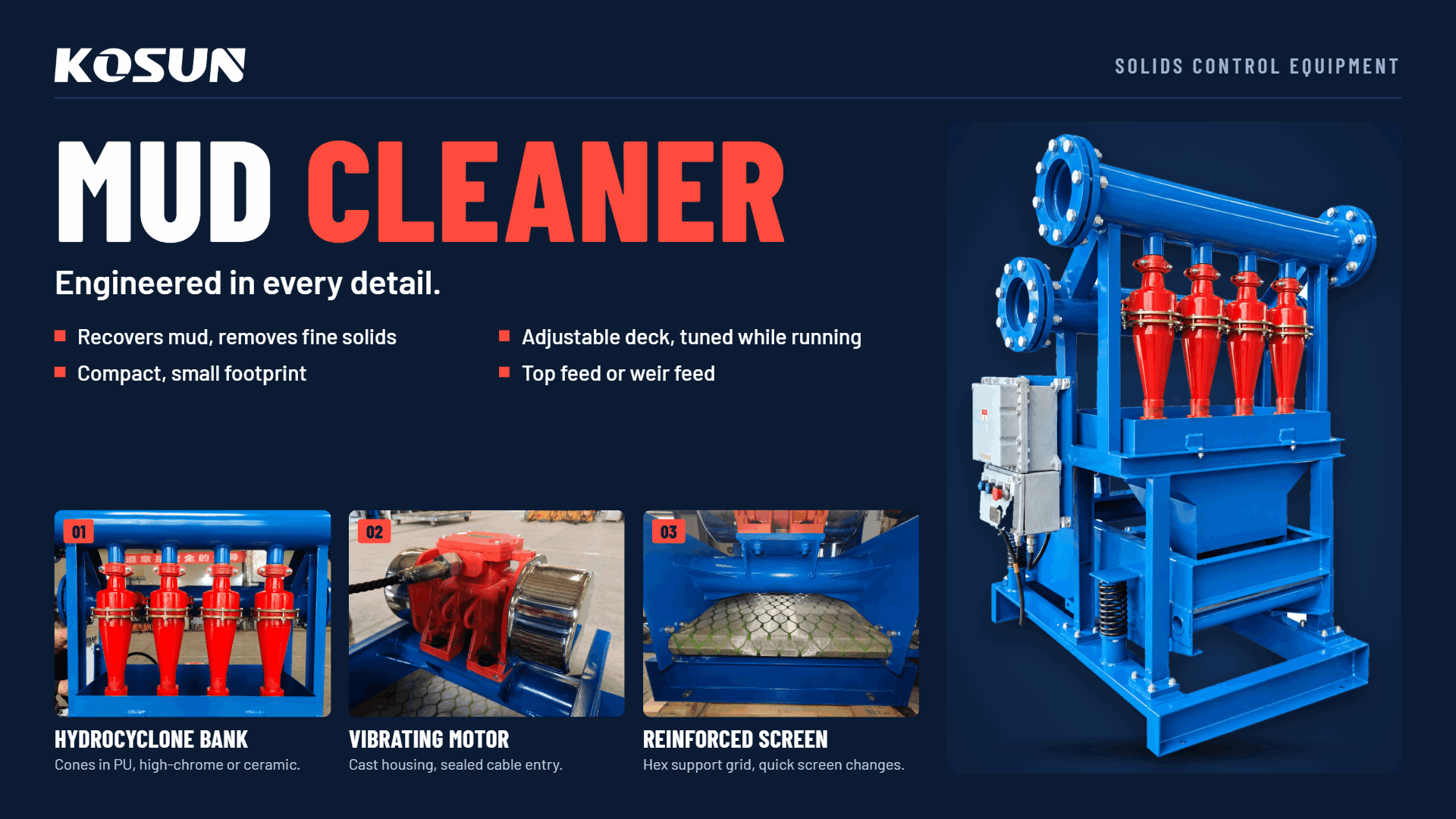
Beyond Primary Screening
A shale shaker removes larger solid particles from returning drilling fluid. However, the fluid passing through the screen may still contain finer sand, silt and other unwanted solids.
A mud cleaner combines hydrocyclones with a vibrating screen to address this remaining solid content.
The hydrocyclones separate particles through centrifugal action. Their underflow, which contains concentrated solids and recoverable liquid, is then processed by the vibrating screen. The recovered liquid can return to the circulation system, while separated solids are discharged for appropriate handling.
The two stages work together to improve solids separation without requiring the operator to treat the entire process as a single screening operation.
How Mud Cleaners Support Drilling Fluid Management
Maintaining drilling fluid properties
Unwanted solids can influence the density and viscosity of drilling fluid. Removing suitable fractions of these solids helps operators manage fluid properties in line with operational requirements.
Supporting fluid recovery and reuse
The vibrating screen recovers liquid from the hydrocyclone underflow. This recovered fluid can be returned to the circulation system when its properties meet the relevant requirements, helping reduce unnecessary fluid losses.
Managing equipment loading
Removing solids at the appropriate stage can help limit the accumulation of unwanted particles in downstream equipment. The actual benefit depends on the drilling fluid, separation configuration and operating conditions.
Making efficient use of site space
The integrated hydrocyclone-and-screen arrangement combines two separation functions in one unit. This can simplify equipment layout where available installation space is limited.
The Mud Cleaner Is One Part of a Larger System
Effective drilling fluid recycling depends on the performance of the entire solids control process rather than one machine alone.
Primary screening, hydrocyclone separation, subsequent treatment and fluid property monitoring all contribute to the final result. Screen selection, cone configuration, flow rate and the characteristics of the drilling fluid must be considered together.
Separated solids also require appropriate collection and handling. A mud cleaner supports drilling fluid purification, but it does not replace the additional treatment processes that may be required for drilling waste.
For drilling contractors, the objective is to establish a practical balance between fluid recovery, solids removal, equipment operation and site-specific requirements.
KOSUN focuses on solids control and mud treatment solutions that support more efficient fluid management across drilling and infrastructure applications. Selecting the right separation equipment is one step toward a well-coordinated and resource-conscious treatment process.