

Horizontal Directional Drilling Technology
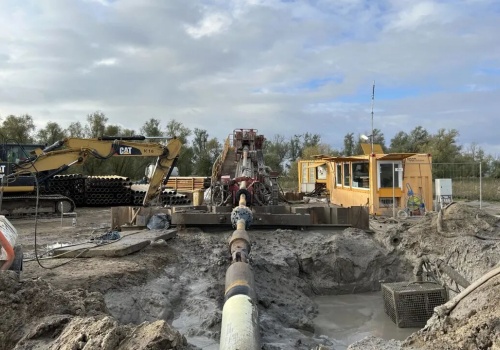
Horizontal Directional Drilling (HDD) is a core technology for trenchless underground pipeline laying. A pilot hole is first drilled using a directional drilling tool, then the hole is gradually enlarged to the appropriate pipe diameter, and finally the pipeline is pulled back to complete the laying. It can cross obstacles such as roads, rivers, and buildings with minimal surface damage and is widely used in gas, communication, and drainage pipeline construction.
Mud Performance
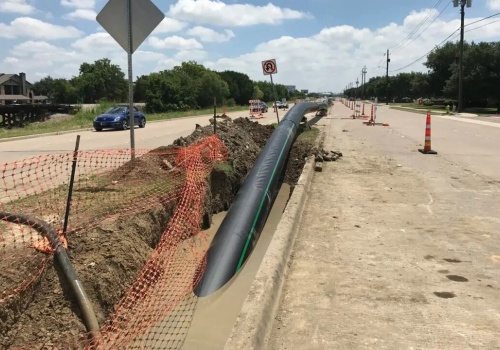
In horizontal directional drilling (HDD) operations, mud (drilling fluid) plays a crucial role. Mud performance directly affects drilling efficiency, borehole stability, and drill string lubrication. The following are the main performance requirements for HDD mud:
Carrying Drill Cuttings: The mud must have good suspension capacity to ensure that drill cuttings are effectively carried out of the borehole.
Lubricating Drill Strings: Reduces friction between the drill pipe and the borehole wall, lowering torque and drag.
Stabilizing the Borehole Wall: Prevents borehole collapse and diameter reduction, especially in loose formations or aquifers.
Cooling the drill bit: Reduces drill bit temperature and extends its service life.
Controlling formation pressure: Balances formation pressure and prevents water inrush or leakage.
Solids Control Methods
To remove drill cuttings, sand particles, and other impurities from the circulating drilling mud, maintain mud performance stability, and achieve efficient reuse and environmentally friendly treatment of the mud, solids control of HDD mud is necessary.
Without solids control, drill cuttings will accumulate in the mud, leading to abnormal mud viscosity and density, impairing its sand-carrying, wall-protecting, and lubrication functions, easily causing accidents such as stuck drill bits and borehole collapse; it will also accelerate drill bit wear, increase mud consumption and waste disposal costs, and even cause environmental pollution.
Currently, the commonly used methods for solids control of HDD mud are sedimentation, dilution, and mechanical removal.
Sedimentation: A mud pit or more is dug at both the entry and exit points of the drilling. Returned mud is introduced into the pits. After a certain period of natural settling, the upper liquid phase is extracted and reintroduced into the mud circulation, while the bottom solid phase is discarded. Advantages: Simple operation, low cost, low energy consumption; Disadvantages: Large site occupation, slow settling and separation speed, and difficulty in removing the bottom solid phase.
Dilution: The mud returned from the crossing is recycled into the mud tank, and then water, sodium carbonate, and additives are added to adjust the mud properties to meet the crossing requirements, thereby reducing the solid content of the mud. Advantages: Simple method, low cost; Disadvantages: Incomplete solid phase removal.
Mechanical Removal: This method uses a solid phase control system to separate the solid phase. The solid phase control system refers to a system composed of a mud shale shaker , desander, desilter, mud cleaner, decanter centrifuge, and circulating tank, etc., according to the requirements of solid phase control. In most cases, mechanical removal is the most effective and economical.
Kosun KSMR Series Products
Kosun‘s KSMR series mud recycling system is the core equipment for mud circulation in trenchless construction. These systems employ a two-stage or three-stage solid-phase controlled separation design, effectively removing solid particles from the mud, maintaining mud performance, saving construction costs, and meeting environmental protection requirements.
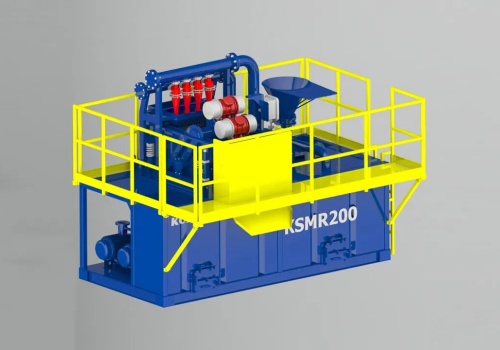
1. KSMR-200 HDD Mud Recycling System
The KSMR-200 mud mixing system uses a two-stage separation design (shale shaker + desilting hydrocyclone), achieving a processed particle size of 20μm. It uses a shale shaker underflow screen as a pre-screen to remove particles >1.5mm; and a desilting hydrocyclone to remove particles from 0.02mm to 1.5mm. The system’s processing capacity can reach 50m³/h.
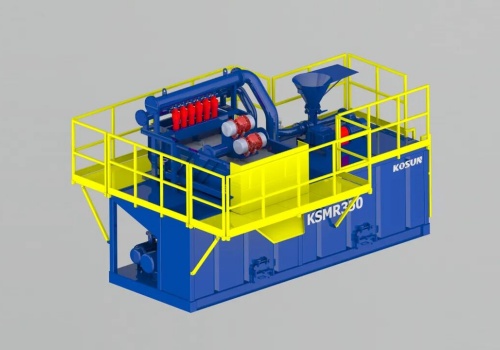
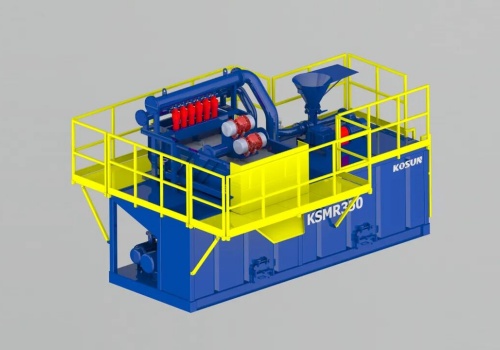
2. KSMR-350 HDD Mud Recycling System
The KSMR-350 mud cleaning system also uses a two-stage separation design (shale shaker + desilting hydrocyclone), achieving a processed particle size of 20μm. It uses a shale shaker underflow screen as a pre-screen to remove particles >1.5mm; and a desilting hydrocyclone to remove particles from 0.02mm to 1.5mm. The system’s processing capacity can reach 80 m³/h.
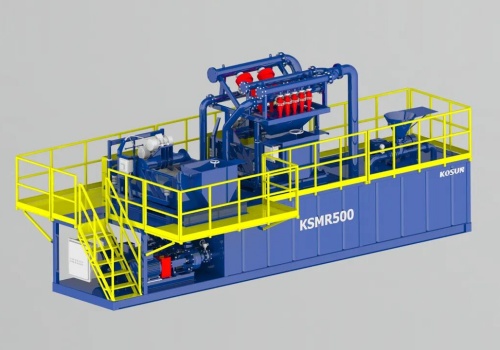
3. KSMR-500 HDD Mud Recycling System
The KSMR-500 hdd mud mixing system adopts a three-stage separation design (shale shaker + desanding hydrocyclone + desilting hydrocyclone), and the treated particle size can reach 20μm. It uses a shale shaker underflow screen as a pre-screen to remove particles >1.5mm; a desanding hydrocyclone removes particles from 0.074mm to 1.5mm; and a desilting hydrocyclone removes particles from 0.02mm to 0.074mm. The system’s processing capacity can reach 120 m³/h.
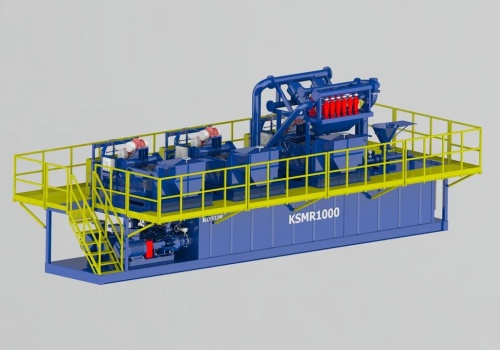
4. KSMR-1000 HDD Mud Recycling System
The KSMR-1000 drill mud recycling system adopts a three-stage separation design (shale shaker + desanding hydrocyclone + desilting hydrocyclone), and the treated particle size can reach 20μm. It uses a vibrating underflow screen as a pre-screen to remove particles >1.5mm; a desanding hydrocyclone to remove particles 0.074mm~1.5mm; and a desilting hydrocyclone to remove particles 0.02mm~0.074mm. The system’s processing capacity can reach 240m³/h.